
 Shivangi Sinha
In May 1999, concern arose when 66-year-old Angela Spence-Hsaw failed to show up for work. A worried coworker went to check on her at her home in Little Compton, Rhode Island, where Angela was found dead. The house showed clear signs of a violent struggle and was heavily stained with blood. Police immediately launched an investigation and collected forensic evidence from the scene. DNA samples and distinctive footprints proved crucial, allowing investigators to quickly narrow in on a suspect and piece together what had happened. The case, including how the killer was identified and the motive behind the crime, is explored in Investigation Discovery’s ‘Homicide Hunter: American Detective’ episode titled ‘Blood Bath.’
Angela Spence-Shaw Had Sustained Multiple Injuries Before She Passed Away
Angela M. Spence-Shaw was born in 1933 in Southgate, North London, England, to her parents, John and Margaret (Eade) Carter. From a young age, she was energetic and driven and even competed as an amateur runner and hurdler for Hertfordshire County. She later married Bernard Spence and relocated to Norton, Massachusetts, where she managed The Campus Shop on Howard Street at Wheaton College. The marriage eventually ended in separation. Angela later found companionship again with Peter Van Cleve Shaw, whom she married. After spending some time continuing her work at the shop, Angela and Peter moved to Little Compton, Rhode Island, in the late 1970s, where they settled into a new chapter of their lives.
Angela led a full and engaged life and remained deeply involved in her community. She volunteered at Blithewold Mansion and Arboretum in Bristol and at Marie’s Place in Fall River, giving her time generously to causes she cared about. She was an active member of the Little Compton Garden Club and had been named president-elect, and she was also affiliated with Endolane Stables. Angela was a devoted mother to her two sons, Gerard and Justin Spence, and a loving stepmother to Geoffrey Shaw and Penny Evans. Her sister, Patricia Hilsey, remained in England, but the two sisters stayed closely connected and spoke often. All of her four grandchildren doted on her. By 1999, Angela was living independently in her Little Compton home as a widow, content with her life and at peace with the path it had taken.
On May 30, 1999, the 66-year-old failed to show up at work, prompting concern from a coworker who went to check on her at home. Inside the house, she discovered Angela’s remains in the upstairs bathroom. Angela was wearing only a pink nightshirt, and the bedroom showed clear signs of a violent struggle, with blood throughout the space. She was found in a full bathtub, with an electric hairdryer also inside. Police were immediately called and secured the scene. An autopsy later determined that Angela died from drowning and sustained significant blunt-force trauma to the head. She had sustained multiple injuries, broken bones and even showed signs of a sexual assault.
Angela Spence-Shaw’s Killer Willingly Provided His DNA Sample For Testing
At the time of the killing, renovations were underway at Angela Spence-Shaw’s home. Just two days earlier, on May 28, 1999, part of a wall had been knocked down to make way for an extension, leaving the house temporarily unsecured and easier for someone to enter. The police believed that the attack had been carried out by someone who knew about the temporary access. Despite this, investigators found no signs of burglary, as valuables such as cash and jewelry were left undisturbed. From the crime scene and Angela’s remains, police recovered DNA believed to belong to the attacker, which became a crucial piece of evidence. Investigators questioned people in her circle, including the construction crew, and learned that one worker, Jeremy Motyka, had not returned to work after the incident.
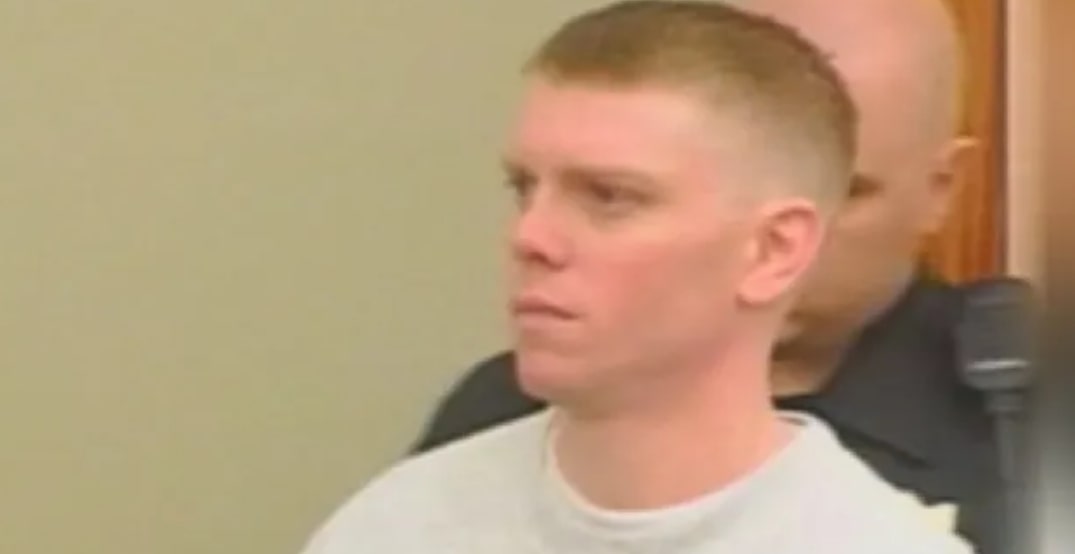
On May 31, police went to Jeremy Motyka’s home in Fall River, Massachusetts, where he lived with his girlfriend, Patricia Rogalin, and their young son. When questioned about his movements, Motyka said he had left Little Compton around 3 pm and spent the evening at home drinking alone. Rogalin told investigators that the rest of the family had traveled to Cape Cod for the weekend and that Motyka had opted not to join them, saying he was tired and did not want to make the drive. Despite these statements, investigators remained uneasy and asked Motyka to return for a formal interview on June 3, 1999. During this interview, Motyka provided inconsistent accounts of his whereabouts.
He now claimed that he went to a bar around 6 pm, returned home to order pizza, and later drank with his teenage neighbor until about 1 am before going to sleep. He continued to insist that he never left Fall River and had no involvement in the incident. Investigators had recovered a large footprint from the bathroom and asked Motyka to provide a footprint for comparison. On June 9, police requested DNA samples from 23 members of the construction crew who had worked at the house so the profiles could be compared with DNA recovered from Angela’s remains. Motyka voluntarily submitted his DNA sample. The samples were sent for forensic analysis, and only one DNA profile match was found for Jeremy Motyka. On June 24, 1999, Motyka was formally charged with first-degree murder and first-degree sexual assault. He was taken into custody the same day.
Jeremy Motyka is in a Maximum Security Prison in Rhode Island Today
Jeremy Motyka’s trial began in January 2001. His defense argued that although the DNA evidence belonged to him, it had been planted by an unknown third party and that he had no involvement in the violent crime. The prosecution, however, presented a strong, evidence-based case. In April 2001, Motyka was convicted on both original charges, first-degree murder and first-degree sexual assault. He was sentenced to life imprisonment without the possibility of parole for the murder, along with a concurrent life sentence for the sexual assault.

Motyka appealed his conviction in 2002, but it was upheld in January 2006. Further attempts at post-conviction relief were denied by the Newport Superior Court in December 2014 and later affirmed by the Rhode Island Supreme Court in 2017. Now 50, Motyka remains incarcerated in a maximum-security facility within the Rhode Island Department of Corrections, where he will spend the rest of his life.
Read More: Elena Wysong Murder: Where is Brandon Wysong Now?

