
 Abhiroop Das
Helmed by Rob W. King, ‘Distorted’ tells the mind-bending story of Lauren Curran, who slowly comes to realize that her hi-tech apartment complex is rigged with subliminal messaging devices, which are silently implanting violent ideas into the minds of everyone who responds to such stimuli. Having recently moved into this secure location to cope with her traumatic past, Lauren finds life here unbearable and decides to revolt against the shadowy overlords who are conducting this experiment on every resident in the complex. However, with her loved ones casting doubt on everything she does, Lauren is forced to look inwards and confront her own inner demons. At the end of this science fiction thriller movie, Lauren’s life is at stake, and she must definitively decide what is real and what isn’t, before it’s too late. SPOILERS AHEAD.
Distorted Plot Synopsis
‘Distorted’ begins with Russell and Lauren moving into The Pinnacle, a hi-tech residential complex designed to maximise security. The couple has a very specific reason for moving in, as not long ago, a home invasion ended with the death of their infant son. Lauren is still deeply traumatized by this incident, and has been battling with bipolar personality disorder since. However, her excitement about the new place is short-lived, as it is replaced by fear and uncertainty when she attends a cocktail party hosted by other residents. There, she notices strange sounds, lights, and texts flash on screens and in sound systems, but no one seems to realize this. Soon, the problem creeps into her house, and while Russell claims that she is imagining things, Lauren is determined in her belief that her house has been bugged.

Lauren’s research ultimately leads her to the concept of subliminal messaging, wherein people are exposed to hidden stimuli numerous times until an idea is embedded into their subconscious without them even realizing. For some reason, Lauren is the only one who can perceive the bursts of subliminal messaging at her home and everywhere else in the apartment complex, and even talking to the resident advertisement mogul, Philip Starks, doesn’t help. Enter Vernon Sarsfield, an underground hacker and journalist who shares her belief that the complex is a part of a brain programming experiment. Together, they break into the smart facilities’ mainframe and realize that they are using high-grade technology to insert themselves into people’s everyday lives.
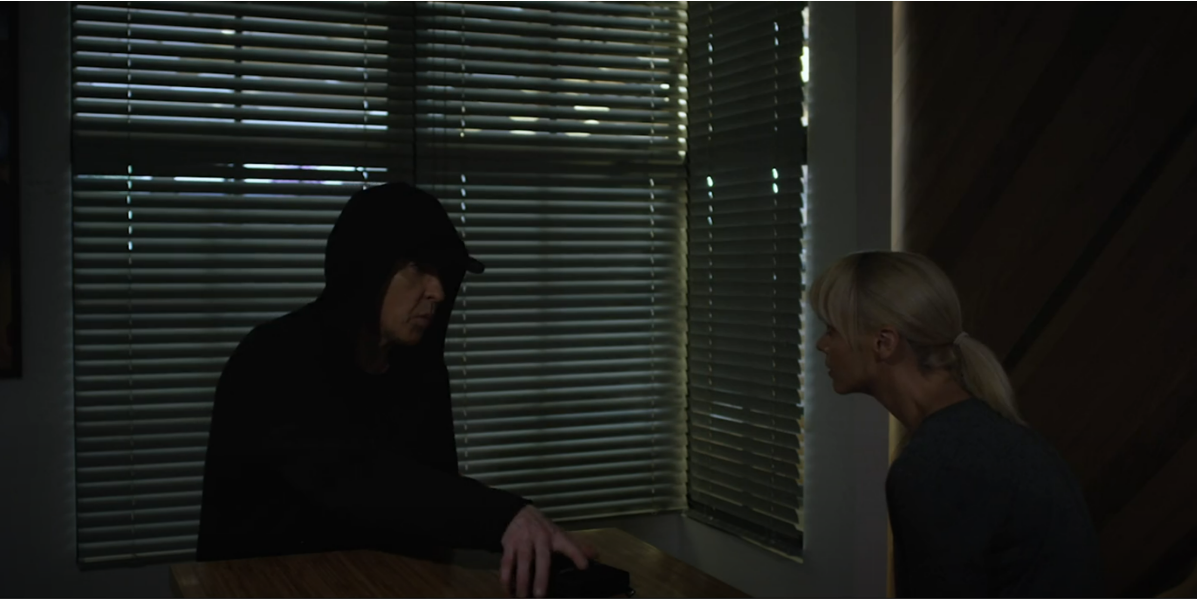
Before long, Lauren’s snooping around and resistance towards subliminal programming turn her into an active target, and it is revealed that this entire experiment is being conducted by none other than Starks. Refusing to give up, he forcibly kidnaps Lauren and forces her to watch hours of subliminal messaging footage, which culminates in commanding her to kill a child named Ali. Luckily, Vernon is there to save her at the last minute and helps her regain her senses just in time. While he holds Starks’ men back, ultimately sacrificing himself, she escapes, only for things to seemingly go wrong once again. Still in a frenzied state, she kidnaps Ali, not even stopping when Russell tries to help her. Just when it seems that Starks’ plan worked, Lauren’s real plan comes to light.
Distorted Ending: Has Russell Bugged Lauren’s House? Is He Still Brainwashed?
At the end of ‘Distorted,’ Lauren and Russell defeat Sparks and leave The Pinnacle behind, but that doesn’t mean that they are entirely out of danger, be it physical or psychological. Some time has passed, and we see that Lauren is now pregnant and has moved into a brand new house with her husband. In the final scene, the duo tries to get their baby cam working before Lauren ponders if it’s better that it doesn’t. This marks a stark shift from their attitude at the start of the story, where they were quite enthusiastic about moving into a smart home. The apartment’s subliminal messaging appears to have triggered a disillusionment with technology as a whole, which explains why Lauren eyes the baby cam suspiciously in the final frame of the movie.

While Lauren’s final expression on-screen can be interpreted as a representation of how she will never quite be able to confidently distinguish reality from illusion ever again, there is also a literal angle to it. Notably, we never actually confirm that Russell has gotten over his brainwashing, no matter how little or how much it has impacted him. However, he is the one who saves Lauren from certain death at the last minute; all of his actions from then on can easily be attributed to a degree of psychological programming. Another important detail is the supposed chip implanted in each resident’s body. In several scenes, we see Russell scratching his neck, and since this chip is never brought up again, it’s possible it is still lodged in his system, guiding his actions.

In a way, Lauren can likely never escape the technological hell she finds herself in, both in spirit and in reality. Russell’s struggle with the body cam can very well be a ruse for him to augment it with subliminal messaging software. Earlier in the movie, we see just how controlling and subtly abusive he can be towards his partner, and the fact that he is once again setting up a camera extends that visual motif further. Given that a large part of Starks’ experiments is about stripping people of free will and infantilizing them in a way, such that they can only respond to certain stimuli, there is a chance that Russell is still furthering that idea and that technology. Despite her best efforts, Lauren is essentially trapped in a never-ending rabbit hole of fear and paranoia.
How Did Lauren Fake the Child’s Death?
A large part of Lauren’s victory over Starks is how well she lies about Ali’s death. After hours worth of subliminal messages are injected into her brain, Lauren is given a single goal: to find and kill Ali. From Starks’ perspective, this is the ultimate moral failing a person can have, and for Lauren to do this without second thought would mean that his experiments are a complete success. However, his unquestioning belief in his own technology ends up backfiring, as he is hardly able to tell apart Lauren’s lies from reality. This serves as a role reversal of sorts, as Lauren uses her supposed brainwashing to trick Starks and company into seeing whatever they want to see, while in reality, she concots an elaborate plan to fake the child’s death.

The first step in the simulated process is to actually kidnap Ali, and here we see a dual narrative start to take shape. While Lauren is indeed tasked with taking the child’s life, she also happens to be the only person who can keep her safe, which is why she explicitly reveals to Ali’s family that she is in danger. Next up, she digs through the subliminal images to find an abandoned cabin, which is intended to be the kill site. Going against her predetermined future, however, Lauren turns that into a temporary safehouse and instead adds streaks of fake blood to a bag before filling it with apples, which stand in for severed body parts. With this, Lauren is able to fool Starks long enough that he lowers his guard. Russell is also a key player in this entire scheme, as he not only helps Lauren fill the bag with apples but also ambushes Starks at the right moment, taking control of the situation.

On top of being the perfect con, the scene is also symbolically rich, as the apples can be interpreted as Lauren possessing true knowledge of what is real and what is illusory, or more appropriately, what is just and what isn’t. This is in opposition to Starks, who is so consumed by his own creations that he can no longer perceive the evil that he is perpetuating. On a deeper level, the scene also connects to the tragic death of Lauren’s child, an event she was almost forced to vicariously repeat by killing Ali. By saving her life, however, Lauren brings that arc full circle.
Why Did Starks Conduct the Experiments? What Happens to Him?
Starks’ primary motivation for conducting such elaborate and dehumanizing experiments is never quite spelled out, but a clue emerges in how he talks to Lauren after her mission is supposedly over. He explains that his field, which he has termed psychotechnology, will do wonders for warfare, suggesting that his research is intended to create a class of supersoldiers with no will of their own. Given the potency of subliminal messaging, it is entirely possible to turn soldiers into mindless drones who can hunt down and kill anyone they are asked to, without any moral inhibitions. This also connects to a previous conversation he had with Lauren, in which he elaborated on how the government banned subliminal advertising due to its harmful effects. As such, it is likely that Starks has been conducting these experiments independently, and his plans for warfare implementation are only hypothetical.

Starks’ psychotechnology comes crashing down when Lauren reveals that she has been playing him all along. Before he can attack her, Russell storms into the room and shoots Starks in the chest, killing him instantly. At the same time, the police arrive and surround the building, resulting in the swift arrest of all of Starks’ workers, who were posing as residents all along. While we are never shown what happens to The Pinnacle after this moment, it is likely that the entire complex is shut down, and the innocent residents are rescued. Still, the process of undoing the brainwashing is bound to be a long and challenging one, and there are many who might never recover fully. Lauren’s exceptional resistance to brainwashing is the only reason they are saved from a potentially worse future.
Why is Lauren Immune to Subliminal Messaging?
Lauren, alongside her neighbor, Tim Boyle, is the only person who can not only perceive subliminal messaging attempts but also resist them to a great extent. While Tim ultimately takes his own life, Lauren keeps the psychological programming at bay to the bitter end. The reason for her unique immunity is often theorized within the movie, but no clear answer emerges. The most likely reason, however, is her experience with bipolar personality disorder, which has helped her gain a keen insight into the minute differences in one’s actions, thoughts, and behaviors. The numerous images flashed throughout the movie are simultaneously an extension of Starks’ subliminal messaging and also a collage of her own memories, which have, over time, strengthened her resistance.
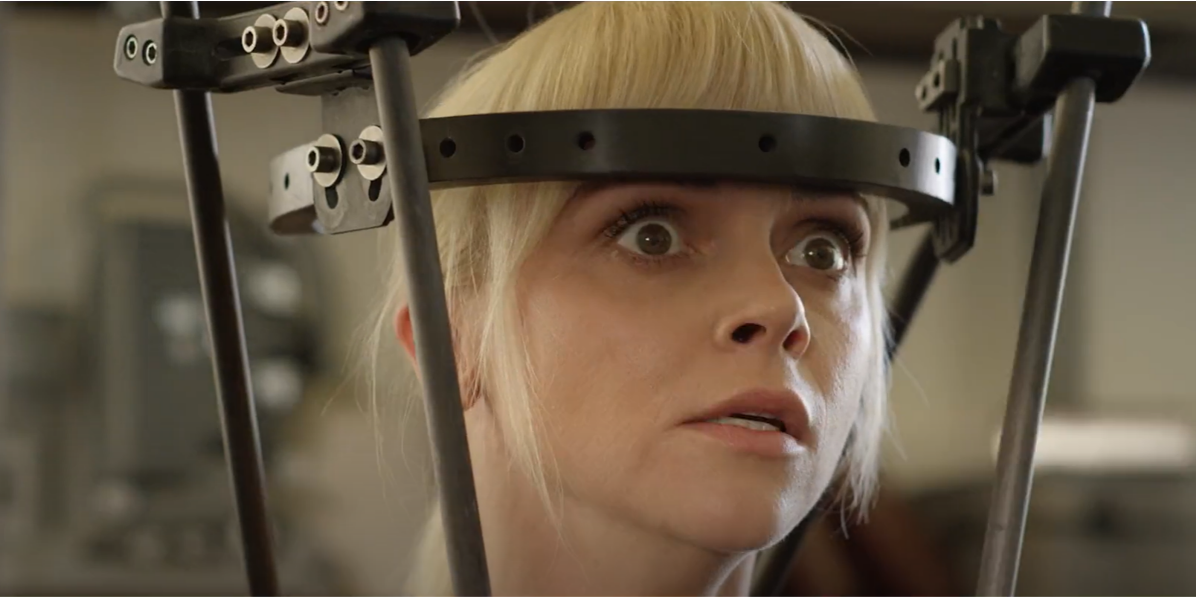
While Lauren naturally manages to surpass Starks’ psychological programming, many of her near and dear ones at The Pinnacle are not as lucky. Most notably, Russell himself almost becomes a target of the mass brainwashing, and only realizes the truth when he sees what happened to Lauren with his own eyes. This marks an important thematic distinction, as Starks’ entire operation is contingent on subliminal messaging that cannot be readily perceived and actively understood. His efforts to subdue Lauren lead him to forcefully make her watch nothing but images of cruelty and manipulation, which takes subliminality out of the equation. It is this critical error on Starks’ part that leads Russell directly to the truth and Lauren.
Read More: Is Taskaree a True Story? Is the Chaudhary Syndicate Based on a Real Smuggling Ring?

