
 Abhiroop Das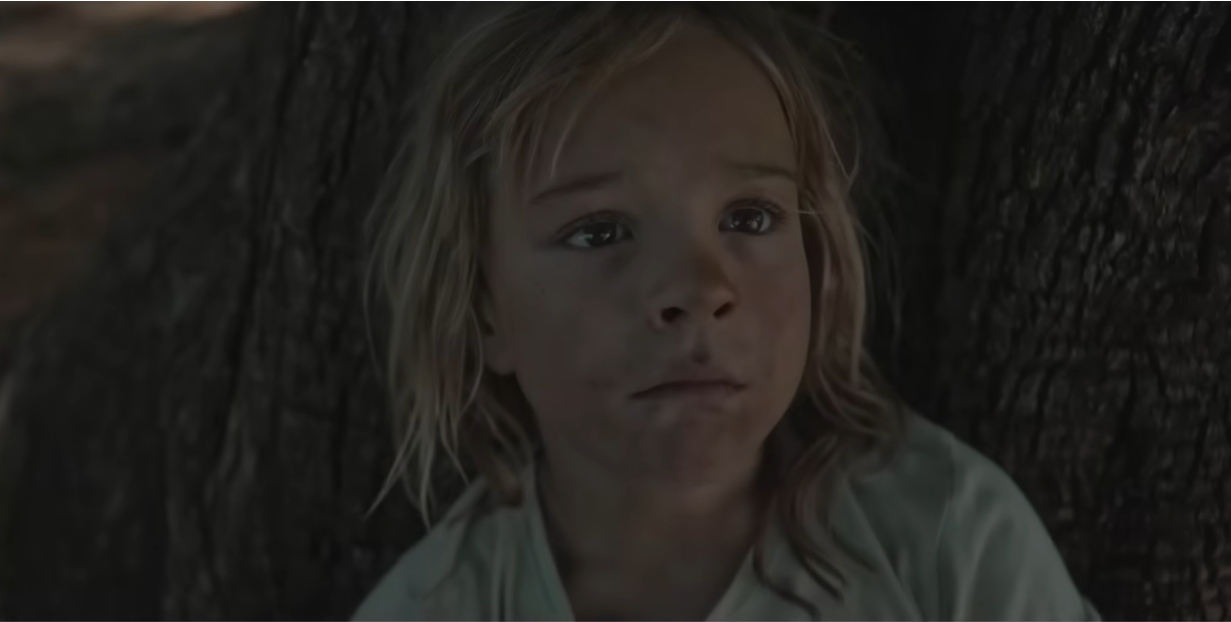
Helmed by Embeth Davidtz, ‘Don’t Let’s Go to the Dogs Tonight’ follows Alexandra “Bobo” Fuller’s childhood in Rhodesia during the peak of its internal strife. While on one hand, the white minority government desperately tries to hold on to power, Black nationalist movements, often labelled as terrorists, continue to fight for their sovereignty. The result is an exchange of brutal, violent episodes, with the Fuller family at the heart of it all. With each day, the challenges continue to mount, and Bobo finds herself struggling with social upheaval as well as a domestic crisis. In charting a real-life crisis through the eyes of an 8-year-old child, this historical drama movie, based on Alexandra Fuller’s eponymous book, shines a light on the subjectivities of a lived experience.
Bobo is Based on the Real-Life Alexandra Fuller, Who Left Rhodesia in the 1980s
Alexandra “Bobo” Fuller, the protagonist of ‘Don’t Let’s Go to the Dogs Tonight,’ is a semi-fictionalized version of the real-life Alexandra Fuller, who spent many years of her childhood in Rhodesia, right around the peak of the Bush War. In 2001, Alexandra published the eponymous memoir to much critical and popular acclaim, and this text serves as the basis of Embeth Davidtz’s on-screen adaptation. Notably, there is one key distinction between how the movie approaches Alexandra’s life and how events transpired in real life, and it has to do with time. Specifically, Davidtz’s conversations with IndieWire indicate that the movie intentionally condenses much of Alexandra’s decades-spanning work to a single year, so as to maximise the narrative effects.
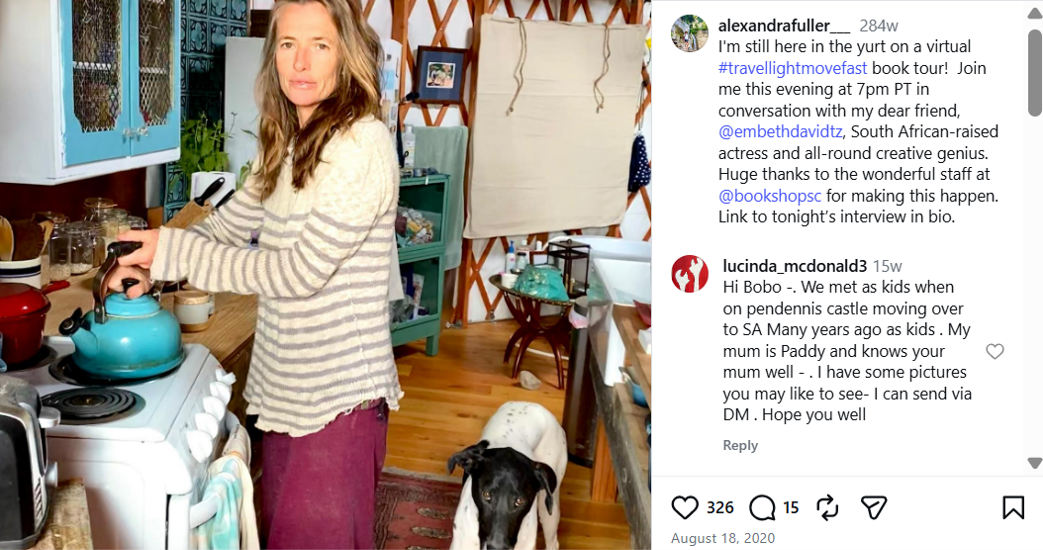
Given Davidtz’s take on the memoir more resembles a snapshot of Alexandra’s life, it is natural for the on-screen version of Bobo to harbor some major creative additions. Still, the general narrative progression is consistent with how her time in Rhodesia panned out in real life. Born to Tim and Nicola Fuller, Alexandra was three years old when her family settled next to a town named Karoi, where much of her early childhood was spent. Across her memoirs, Alexandra details a number of real-life incidents that she vividly remembers, in no small part due to the rising sociopolitical crises that emerged during the Bush War. She seemingly even learned how to handle a gun, look out for landmines, and keep track of dangerous animals all at an early age. Following Robert Mugabe’s victory in the 1980 elections, the Fullers moved out of Rhodesia, marking a significant turn in Alexandra’s life.
Alexandra Left Africa in 1994 and Became a Writer and Mother of Three
After leaving Rhodesia, Alexandra’s family moved to Malawi in 1982 and later to Zambia sometime around 1987. As a young adult, she left southern Africa to study English literature at the University of Dundee in Scotland. Two years later, she moved to Acadia University in Nova Scotia, from where she got her bachelor’s degree in English literature. After university, Alexandra returned to Zambia, and it is here that she met Charlie Ross, a safari tour operator and rafter, whom she described as “someone who wasn’t a stranger to adventure, but yet who was not unpredictably, superfluously dangerous,” in her other works. The two got married soon after, following which they stayed in Lusaka, the capital city of Zambia, where Charlie set up his own safari and rafting business.
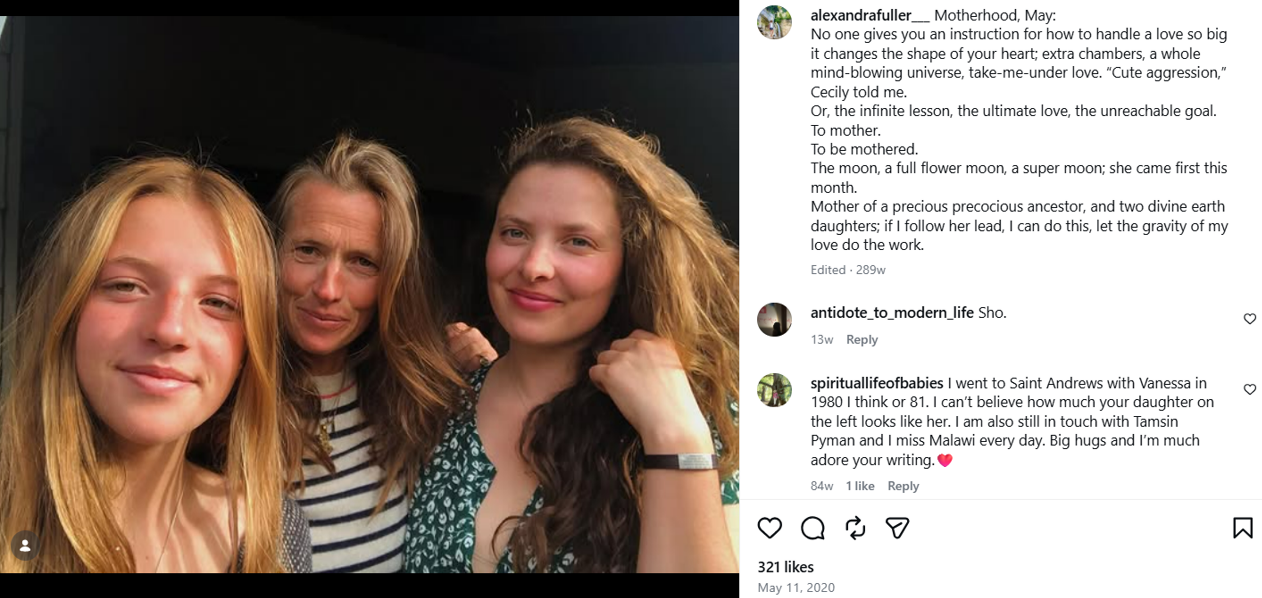
While Alexandra initially didn’t intend to leave Africa, things changed when she fell ill with Malaria, nearly losing her life to the disease following the birth of her first child. This, coupled with the growing domestic and political tensions, compelled her and Charlie to move to his native Wyoming in 1994. As per reports, Charlie got into the real estate business while living in the Cowboy State, whereas Alexandra took to writing and began penning the memoir that would go on to become her world-famous debut work. The couple later welcomed three children into the world: two daughters, Sarah and Cicily, and a son, named Fuller “Fi” Ross.
‘Don’t Let’s Go to the Dogs Tonight’ was published in 2001 and went on to win the Winifred Holtby Memorial Prize the following year. It was recognized worldwide for its incisive commentary on life in Rhodesia, as well as its insight into how racism continues to persist in the region in subtle ways. Alexandra followed it up with ‘Scribbling the Cat’ in 2004, expanding on the aftermath of the Rhodesian Bush War. The work was heralded as a great literary accomplishment and went on to win the Lettre Ulysses Award the following year. Switching things up, Alexandra published ‘The Legend of Colton H. Bryant’ in 2008, which talks about the titular Wyoming oil worker’s tragic death in 2006. Later, in 2011, she penned a sequel to her debut work, this time with a memoir about her mother, titled ‘Cocktail Hour Under the Tree of Forgetfulness.’
Alexandra Continues to Write and Stand Tall in the Face of Hardships
Alexandra and Charlie’s marriage broke up over the following decades due to mutual differences, and the duo ultimately parted ways in 2012 after around 20 years of being together. She has given a candid account of her married life in Zambia and Wyoming through her book, ‘Leaving Before the Rains Come,’ which came out in January 2015, and was followed by her first full-length novel, ‘Quiet Until the Thaw’ in 2017. A year later, in July of 2018, tragedy struck Alexandra’s life when she learnt that her son, Fi, had passed away in his sleep. As per reports, Fi had returned from Argentina after a stress-driven seizure incident, but nothing could prepare the family for his sudden passing. The incident left a hole in Alexandra’s life, and her 2024 work, ‘Fi: A Memoir of My Son,’ captures her journey since.

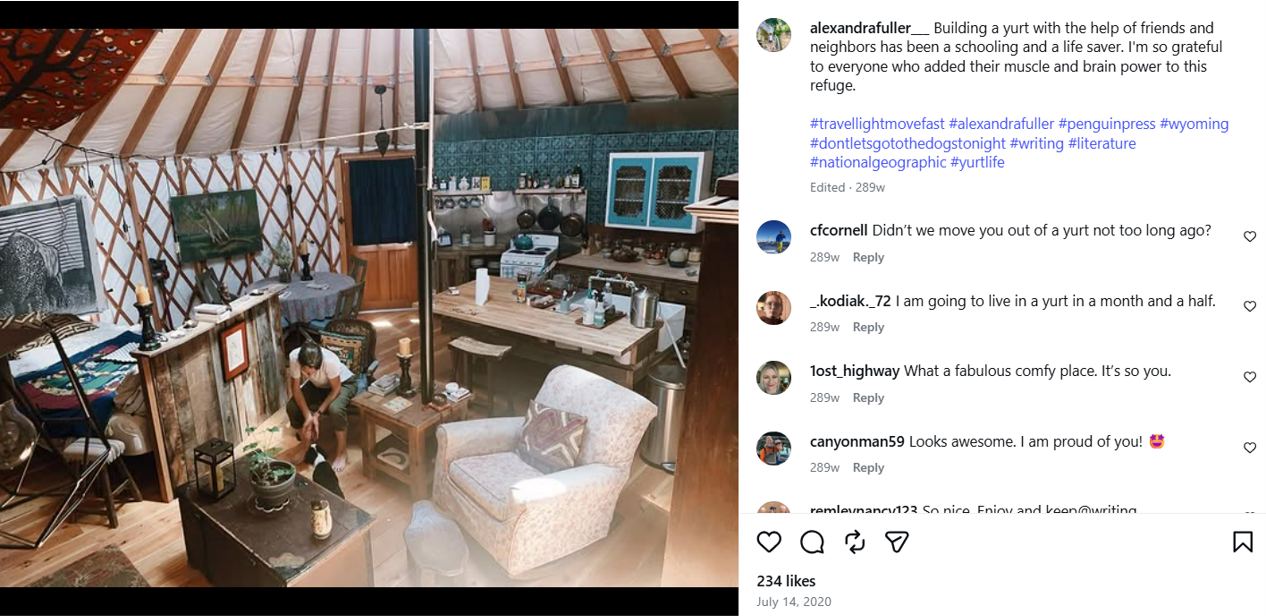
Following the dissolution of her marriage, Alexandra reportedly began spending time in a yurt-like structure near Jackson, Wyoming, and it is likely that she has continued on an adventurous trail of life since. While writing is still an integral part of her creative expression, Alexandra is also a travel aficionado and enjoys capturing the best nature has to offer with her camera. Additionally, she is also a dog-lover, and a number of rescued dogs and other animals make up her larger family. She also continues to maintain a deep bond with her two daughters, who are featured in many of her autobiographical works.
Read More: Is Fox’s Memory of a Killer Based on a True Story?

