
 Abhiroop Das
Helmed and co-written by Freddy Macdonald, ‘Sew Torn’ begins with the protagonist, Barbara, elaborating on three possible fates that might befall her following a chance encounter with a briefcase full of money. She is not alone in this exchange, however, as two men have fought over that briefcase before her, and an even greater threat lies waiting in the shadows. Faced with a myriad of possibilities, the audience, along with Barbara, is forced to make a critical choice and then live with its consequences. The result is a divergence of realities and narratives in a manner that defies genre categorization, but can be interpreted as possible timelines. SPOILERS AHEAD.
The First Timeline: The Not So Perfect Crime
Barbara’s journey down the rabbit hole begins with her mending Grace’s wedding dress at the last minute. While Barbara’s decision to intentionally throw the button away is one of pure spite, it ends up working against her. With no spare button, she has to rush all the way back to her shop and chooses to take a shortcut. Both choices are game-changing in their own right, as it is on this journey that she encounters Beck and Joshua, both half-dead after a fierce battle over a briefcase full of drug money. Barbara wants the money desperately, but realizes that she can’t just keep the two loose ends hanging. Her first choice, as such, is to orchestrate a mutual shootout by stringing together the two men and their guns to her car. As she drives, the guns are pulled back into their hands, prompting them to immediately shoot and finish the jobs themselves.
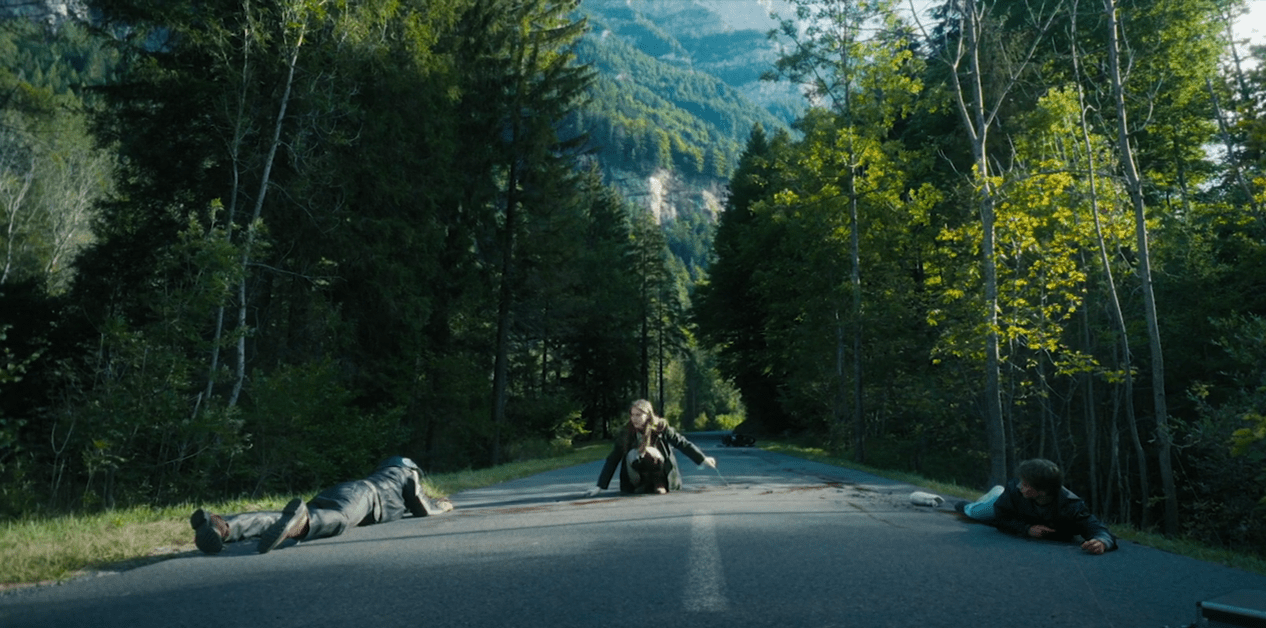
While Barbara’s plan is ingenious, it is chock-full of holes, which ultimately lead to her undoing. One of the men, Joshua, is killed, and the other, Beck, survives. While coming back to retrieve her needles and the briefcase, Barbara realizes that she must either kill him with her own hands or bring him home. She chooses the latter, but that hardly works in her favour. Her other big mistake is forgetting to retrieve the needles, all of which bear her shop’s engraving. It is these pins that lead Joshua’s father, Hudson, directly to her house, following which he shoots both her and Beck to death. Although the first timeline is doomed from the start in many ways, it is her attempt to commit a crime that lands the killing blow.
The Second Timeline: Calling the Police Backfires
Notably, the movie suggests that neither Barbara nor any of the other characters has any recollection whatsoever of the previous timeline. To that end, it is possible that none of the timelines occupy a physical space; instead, they are pure narrative constructs. This also means that Barbara essentially learns no lessons from her previous mistakes, even though her decision in this reality is different. When she chances upon Joshua and Beck for the first time in this reality, she acts on her instinct to call the police. However, on her way out, the briefcase full of cash catches her eye, and, tempted, she decides to steal it. Unfortunately, that turns out to be a blunder, as Officer Engel catches her red-handed and arrests her along with the two men. In a bizarre coincidence, Engel is also the officiator at Grace’s wedding, and it is here that we learn the safety pin used as a temporary fix for the dress has started to dig into her back.
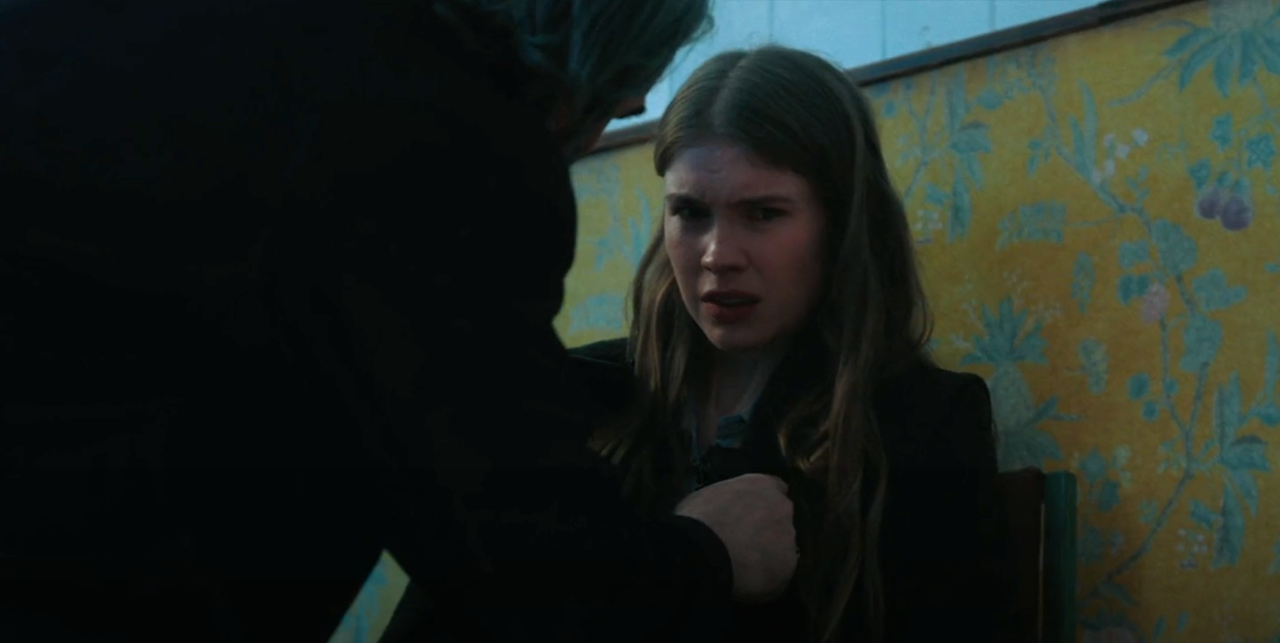
Barbara is called up to fix the dress impromptu, which indicates that Grace is symbolically tied to this entire network of timelines. The same also holds true for the briefcase, as the unifying factor between these two story iterations thus far has been Barbara’s desperate bid for money. The second timeline ends in an even more gruesome fashion, as despite helping Beck escape, Barbara catches the short end of the stick and has to die at the hands of Hudson. If the first timeline calls out her decision to go against the law, this ending brings forth the consequences of only partially aligning with it. In both cases, Barbara’s involvement in the criminal conspiracy only brings her harm, suggesting that the solution might be to ditch the game entirely.
The Third Timeline: Barbara’s Plans Go up in Flames
As she breaths her last in the second timeline, reality starts anew, this time with Barbara choosing to drive straight through the crime scene. Again, her actions are not motivated by the consequences of the previous timeline whatsoever, but her innate desires remain consistent. To that end, we see a repeat of the previous iteration, as Barbara is drawn back to the briefcase full of cash. As she returns, however, she accidentally runs into Hudson, killing Beck and saving his son, Joshua, which makes her a witness. Although she flees the scene and tries to call Officer Engel, neither options work out. In the case of the latter, it is implied that the wedding has already started, and Engel is now busy with officiating duties. This seemingly confirms that all timelines follow the same trajectory, provided no unique stimulus is added into the mix, such as Barbara’s choices.
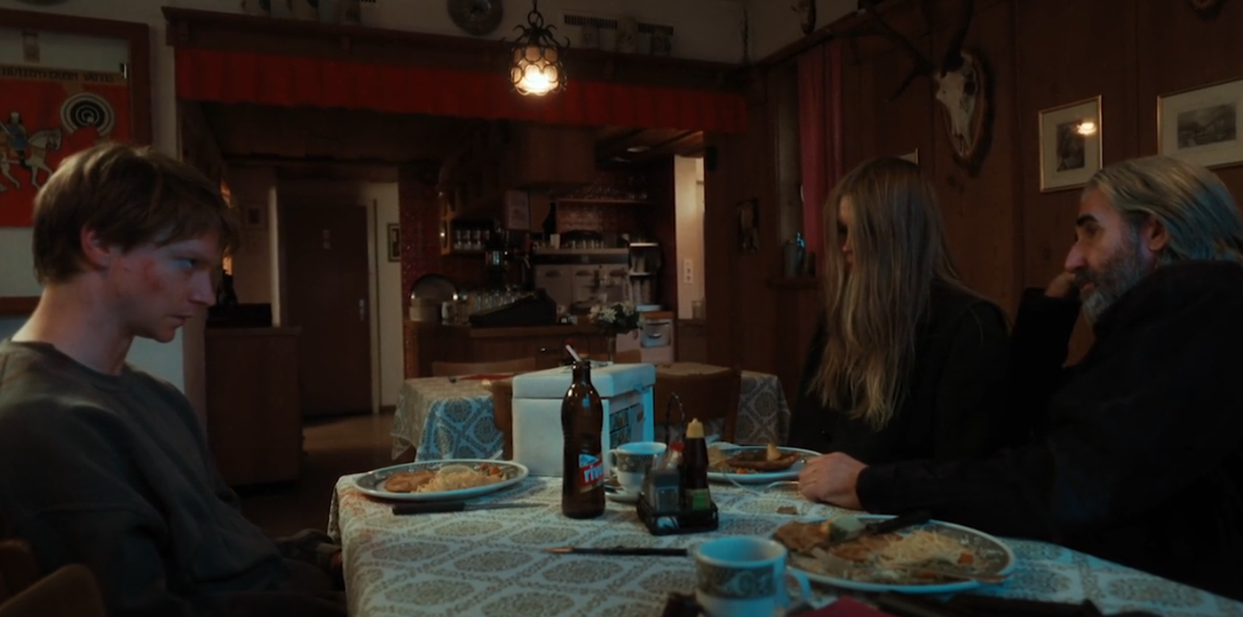
When Hudson ambushes Barbara, she collaborates with an injured Joshua to create yet another string mechanism, this time to redirect Hudson’s gun into his son’s hands. In the previous two iterations, she has exclusively interacted with Beck, be it as a vague ally or an active foe. However, the shift in focus for the third iteration of reality points to its malleability, as no one person is destined to be at odds with her. Still, Barbara’s success is short-lived, as despite taking care of her enemies and escaping with the money, she gets caught up in a bomb explosion. The scene recalls a detail introduced in the first timeline, where we saw Hudson carefully navigate a pressure-sensitive bomb placed under the last stack of money. This confirms that the nature of reality is in sync across all timelines, and Barbara’s choices are the only truly distinguishing factors.
The Fourth Timeline: A Chance to Right the Wrongs
While the three timelines presented thus far have been presented sequentially, forming a trifecta of possible routes introduced at the start of the movie, the fourth timeline comes as a surprise. It is visualized by a merger of three stitched lines, representing the three timelines, which come together to form the shape of a button. With this, the throwing of the button is confirmed to be the true divergence point of reality, and Barbara’s choosing not to do that is what births a fourth timeline. Since she no longer has to rush her way back home, Barbara takes her usual, slower route, where she meets Hudson way earlier than any of her counterparts. Instead of being at the scene of the accident, in this timeline, Hudson is on his way and stops Barbara for directions. Once she complies, he gives her stacks of money as compensation before going on his way. Barbara not only survives the fourth timeline but also comes out rich enough to save her dying business.
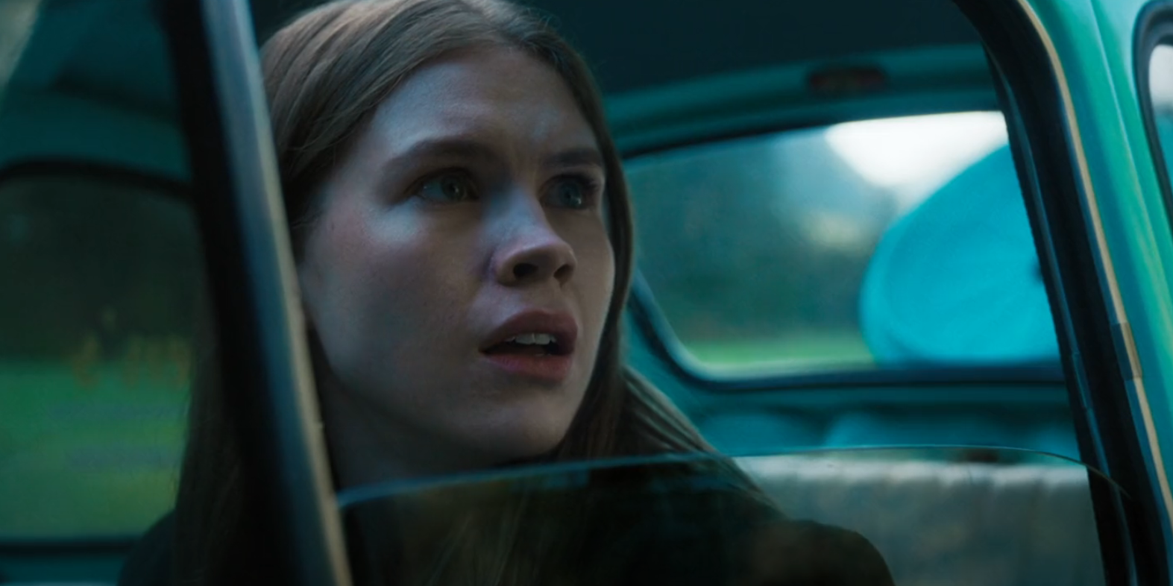
As Barbara does not die in the fourth timeline, there is no actual ending to it, and while the story never claims any timeline to be more or less real than the others, the fourth is the most unique. With the previous three conclusions in mind, Barbara’s decision to throw the button and then steal the money can be interpreted as a part of her self-destructive spiral that results in death. Instead, she frees herself in the fourth iteration and is narratively rewarded for it. Notably, it is entirely possible that there are more possible realities, especially the ones where she chooses to walk away without the money altogether. The fourth timeline, however, is the most fruitful one for her, both on a material and psychological level. While, as a narrator, Barbara expresses full awareness of these timelines, her version within the story is oblivious to the larger structure, which reiterates how the different versions of the story likely only exist within the bounds of the film.
Read More: Is Lifetime’s Toni Braxton’s He Wasn’t Man Enough Based on a True Story?

