
 Naman Shrestha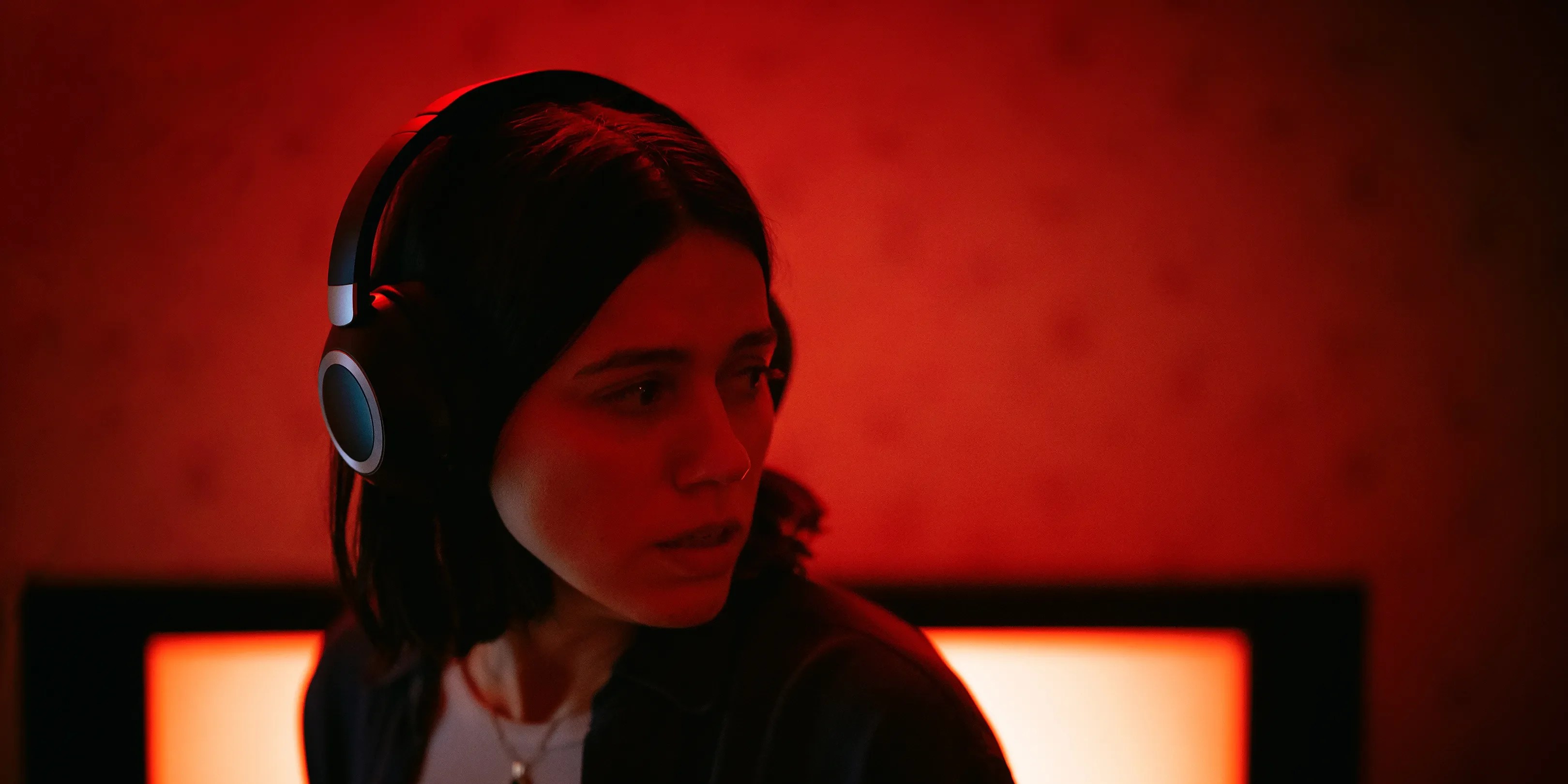
Written and directed by Ian Tuason, ‘Undertone’ revolves around Evy Babic, a paranormal podcaster who is the skeptic to her believer friend and co-host, Justin. In order to tend to her dying comatose mother, Evy moves back into her family home. Her skepticism about the paranormal is thrown out the window when she and Justin receive a series of unsettling recordings of a married couple, Mike and Jessa, who encounter strange noises in their home.
As she digs deeper into the case, Evy links it to a folklore that begins to bleed into her personal life, be it her mother’s condition or her unexpected pregnancy. When she notices strange occurrences in her family home, the podcaster is frightened that a demonic entity might have made its way into her life, sending her into a deep pit of fear and paranoia. The supernatural horror movie is set primarily in Evy’s family home, where she serves as her mother’s primary caregiver. The dark corners amplify the podcaster’s fears as she suspects the presence of something evil within the house.
Undertone Filming Locations
Production on ‘Undertone’ was conducted entirely in Ontario, specifically in the bustling city of Toronto. According to reports, principal photography for the Ian Tuason directorial commenced in the first week of February 2025 and continued for nearly three weeks before wrapping up by the end of the same month.
Toronto, Ontario
The shooting of ‘Undertone’ was conducted extensively in Toronto, Ontario. Interestingly, to paint a pivotal portion of the visual landscape of his directorial debut, Ian Tuason settled on a spot that’s quite personal to him — his childhood home. In the northwestern part of downtown Toronto, the cast and crew visited the property nestled in the quiet neighborhood of Rexdale in the Etobicoke district. In an interview with CBC, the filmmaker offered insights into his process and several decisions he took to bring his vision to life as accurately as possible. Talking about utilizing sound to build tension, he stated: “I had to make the movie bigger than it was, so I made it the only way I could: with sound. I built a soundscape as a bigger layer over a contained space.”
The director employed the split-screen technique to enhance the eeriness. As Evy tapes her podcast, the camera slowly captures the negative spaces such as the basement, the stairs and dark corners, that are usually associated with dread in films of the genre. It is a place packed with memories of several stages of his life, such as his childhood, adolescence, and tending to his parents as they battled cancer. In an interview with Toronto Life, when he was asked whether it made things emotionally heavy for him on set, Ian clarified: “It was nothing. Grieving the loss of both parents is so difficult that, afterward, I realized, nothing will ever be so hard in comparison.”
Ian explained that working with Nina Kiri, who plays Evy, became a “therapeutic” experience “because she understood what I’d endured. She tapped into the part of me that’s in her and portrayed it back to me. It made me feel like I wasn’t alone.” The director also used personal possessions and artworks to add emotional depth to the narrative. The spots and pieces of the place became part of the film to such an extent that the house became a character in itself. Several members of the crew attested to the fact that the house felt alive. “I think everyone on the crew has a story. My first one was … the lights started flickering in my hallway,” the director told CBC.
He further explained, “I sat down at Nina’s table … and the chandelier above me, one of them started flickering. I have this on video.” In the aforementioned conversation with Toronto Life, Ian further added how the drawing on his walls changed meaning over time. “At the end of the film, there are scary childish drawings covering the walls. Our props person said they were kind of cute. She wasn’t wrong. There was something comforting about reframing them that way. After the shoot, I painted the walls the same blue as the evil eye—the symbol of protection,” Ian Tuason concluded.
Read More: Where Was They Will Kill You Filmed?

